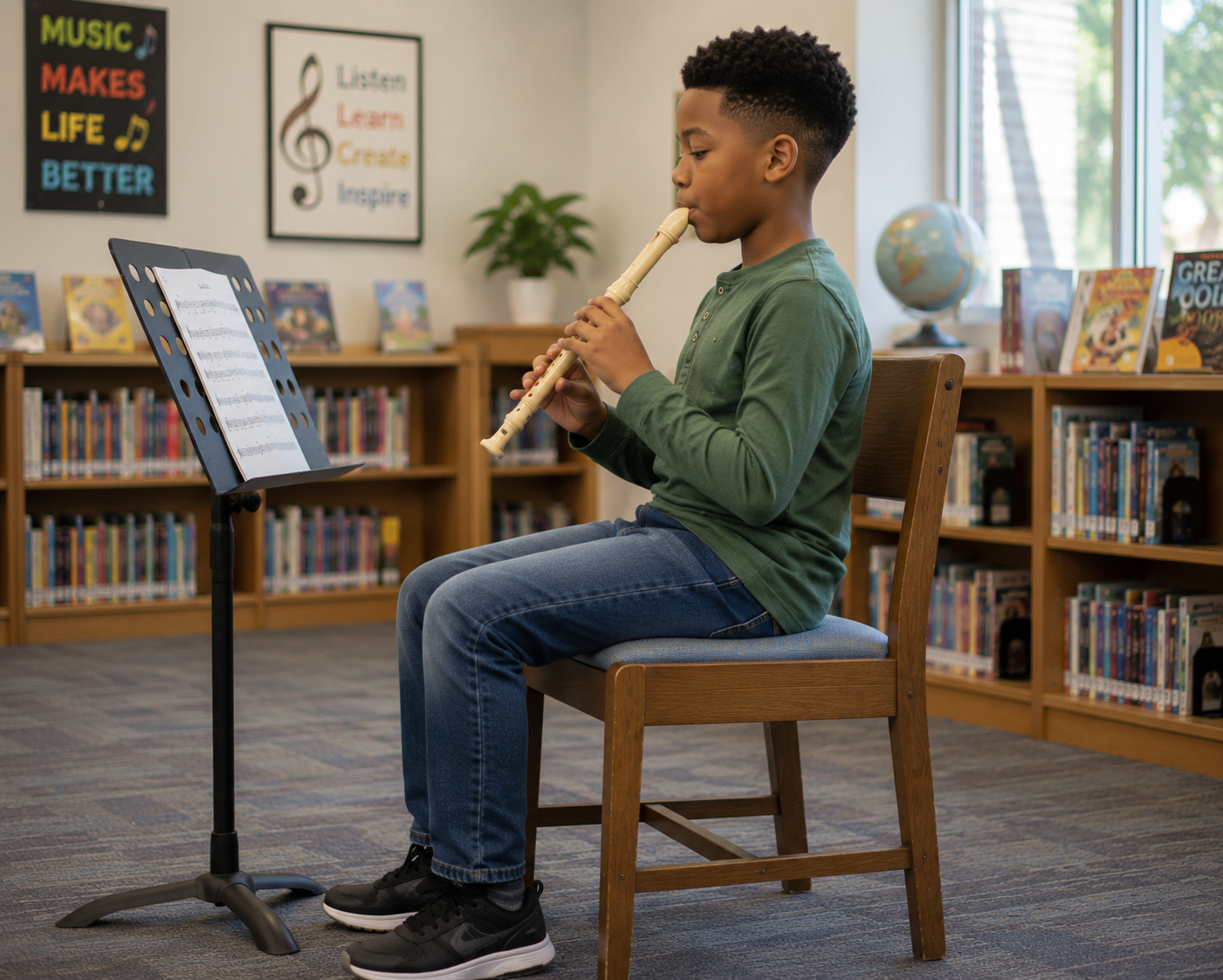
Presto! It’s Recorder Magic
A Comprehensive Beginning Recorder Curriculum Built on the Dennis Frayne Approach to Music Education
Presto! It’s Recorder Magic
Book 1
A Comprehensive Beginning Recorder Curriculum Built on the Dennis Frayne Approach to Music Education
Teach beginning recorder with a clear, thoughtful sequence while helping students become more confident, capable, and complete musicians.
Presto! It’s Recorder Magic, Book 1 is a comprehensive curriculum for beginning soprano recorder, designed especially for individual private lessons, small groups, and classrooms in which students can progress through a rich, connected course of musical study.
Students learn how to hold and play the recorder with healthy technique and a beautiful sound, but recorder playing is only the beginning. Along the way, they sing, listen, clap, read, memorize, study rhythm and theory, develop their ears, use the piano keyboard to understand musical relationships, explore repertoire, and gradually bring these areas together into growing musicianship.
[IMAGE: Book 1 cover]
The Recorder Is the Instrument. Becoming Musical Is the Goal.
Learning the recorder can be about much more than memorizing fingerings and completing songs.
Presto! It’s Recorder Magic uses the recorder as an accessible and rewarding way into the larger world of music. Students develop recorder technique while also learning how pitch works, how rhythm is organized, how music is written, how melodies and harmonies are constructed, how scales and intervals relate to one another, and how listening, singing, reading, playing, and understanding strengthen one another.
This reflects one of the central ideas of the Dennis Frayne Approach to Music Education: music is naturally connected. Singing supports playing. Listening strengthens reading. Repertoire gives theory a meaningful context. Technique serves musical expression. Each new musical experience can help the student understand the others more deeply.
The goal is not simply to produce a student who can play the recorder.
The goal is to help a student become more musical.
Music Before Mechanics
Sound Before Symbol
Students begin making music before they are expected to understand everything they see on the page.
With the first song, Hot Cross Buns, students sing the melody, listen for pitches moving higher, lower, or staying the same, clap the beat, and then learn to play the notes G, A, and B on the recorder. Traditional notation is shown, but the student is not required to master the notation before being allowed to make music.
That sequence matters.
Students experience the music first. They hear it, sing it, feel its beat, play it, and become familiar with its patterns. As notation is introduced more fully, the symbols begin to represent musical relationships the student has already experienced.
This is sound before symbol in practical teaching.
Singing Is Part of Learning the Instrument
Students continue singing throughout the book. They sing lyrics, sing on solfege, clap while singing, and connect the melodies they hear with the notes they play.
Solfege is not treated as an isolated theory exercise. Students use Do, Re, Mi, and the other syllables to strengthen pitch awareness, memory, ear training, and their understanding of scales and melodic relationships. The book explicitly encourages students to return to familiar songs and sing them on solfege as their musicianship develops.
That reflects the larger idea of the Complete Musician: instrumentalists benefit enormously from singing because the voice helps musicians hear music internally rather than relying only upon the physical mechanics of an instrument.
Healthy Recorder Playing from the Beginning
Good musical development requires good physical habits.
Students learn how to hold the recorder gently, place the left and right hands appropriately, cover the holes securely with the pads of the fingers, and keep unused fingers relaxed and ready rather than rigid or tense. The book continually returns to natural posture, relaxed hands, comfortable breathing, and tension-free playing.
Good posture is connected directly to breathing, tone, comfort, and musical success. Students are reminded that healthy recorder playing does not come from gripping or forcing the instrument, but from learning coordinated movements that allow the body to remain free.
[IMAGE: “How to Play the Recorder” hand-position page]
This emphasis reflects a principle found throughout the Dennis Frayne Approach: technique should serve sound and expression while helping musicians play with freedom, coordination, and as little unnecessary tension as possible.
Reading Music with Understanding
Presto! It’s Recorder Magic does not simply hand students a staff full of notes and ask them to memorize where everything belongs.
Music literacy develops gradually.
Students first explore pitch direction and the music alphabet. They connect the musical alphabet with the piano keyboard. They encounter letter names, solfege, patterns, scales, accidentals, half steps and whole steps, and intervals. Traditional staff notation then becomes part of a larger musical system that students are increasingly prepared to understand.
The book even pauses to show students that music has been represented in many different ways. Examples include traditional Western notation, Gregorian chant, ancient forms of notation, Indian notation, guitar tablature, lead sheets and jazz charts, and graphic scores.
The point is larger than learning symbols.
Students begin to understand that music notation is a way human beings communicate musical ideas.
As their reading develops, students study the treble clef, bass clef, grand staff, ledger lines, rhythmic notation, key signatures, dynamics, articulation, navigation, form, tempo, and expression. Although the recorder itself is principally a treble-clef instrument, Book 1 introduces students to both treble and bass clefs at a fundamental level because the larger goal is music literacy, not merely recorder literacy.
The Piano Helps Students See Music
One of the most distinctive features of Presto! It’s Recorder Magic is that recorder students also spend time at the piano keyboard.
This is intentional.
The keyboard provides a remarkably clear visual representation of pitch. Students can see pitches moving higher and lower, discover the repeating music alphabet, observe the patterns of black and white keys, locate half steps and whole steps, compare intervals, build scales, and begin understanding the relationships behind chords and harmony.
Students do not stop being recorder students when they sit at the piano. They are using another instrument to understand music more deeply.
This is an important expression of the Complete Musician philosophy. No one instrument can reveal everything about music. The recorder provides a direct experience of breath, tone, articulation, pitch, phrasing, and melody. The piano makes many theoretical and spatial relationships visible. Singing develops the internal ear. Each perspective strengthens the others.
[IMAGE: Piano keyboard/pitch-direction page]
Theory Students Can Hear, See, and Use
Theory is introduced as part of music making rather than as an unrelated collection of definitions.
Students encounter the music alphabet, accidentals, half steps and whole steps, intervals, scales, keys, modes, key signatures, triads, arpeggios, rhythm, rests, dotted notes, ties, dynamics, articulation, musical navigation, form, tempo, and expression.
They see these relationships on the page. They explore many of them on the piano keyboard. They sing them. They listen for them. And increasingly, they encounter them in the music they actually play.
For example, intervals are explored through letter names, the piano keyboard, the staff, solfege, and the ear. Later, students play a C Major scale, triad, and arpeggio on the recorder, connecting what they have learned conceptually with an authentic instrumental experience.
Theory becomes another way of understanding music rather than something separate from it.
Rhythm Begins with the Beat
Before students are expected to decode increasingly sophisticated rhythmic notation, they repeatedly sing songs and clap the beat.
As the book progresses, students learn how written note values represent duration and how rhythmic notation communicates what musicians have already been experiencing through singing, clapping, listening, and playing. Whole notes, half notes, quarter notes, eighth notes, rests, pickup measures, dotted notes, and ties gradually become part of a musical vocabulary students can connect with actual sound.
Backing tracks reinforce that learning by giving students an enjoyable way to practice playing with a steady pulse, consistent tempo, and an ongoing musical accompaniment.
Repertoire Is Where the Learning Comes Together
Students learn a substantial and varied collection of songs throughout Book 1.
Familiar music such as Hot Cross Buns, Mary Had a Little Lamb, London Bridge, Twinkle, Twinkle, Little Star, Michael, Row the Boat Ashore, Ode to Joy, and Happy Birthday appears alongside repertoire including Duérmete, mi niño, Au clair de la lune, Un elefante, Balonku, Wayfaring Stranger, and other songs drawn from varied cultures, traditions, genres, and musical experiences.
Repertoire is not simply something students complete before turning the page.
Students are encouraged to sing their songs, clap them, play them with backing tracks, memorize them, return to them, and build a collection of music they can perform for other people. The book repeatedly encourages students to prepare a friendly recorder recital and to maintain favorite pieces from memory.
This supports an important principle of the Dennis Frayne Approach: repertoire becomes the living environment in which technique, theory, reading, listening, memory, expression, culture, and performance can grow together.
Built for Real Beginning Students
Presto! It’s Recorder Magic, Book 1 can serve children, teenagers, and adults.
It is appropriate for students beginning music for the first time, but it can also serve students who have already played an instrument and need to strengthen music reading, theory, ear training, rhythm, or other areas of musicianship.
The sequence provides teachers with a clear path while leaving room for professional judgment. Some students will need more repetition. Others will move quickly. A student may already understand one concept while encountering another for the first time.
The curriculum provides structure.
The teacher still teaches the student in front of them.
That balance between thoughtful sequencing and responsive teaching is central to the Dennis Frayne Approach and to the larger Presto! curriculum.
Four Parts. One Musical Journey.
Book 1 is organized into four parts, with review and recognition built into the student’s progress.
Presto the Magician Musician appears throughout the book as a friendly guide, encouraging students as they learn new songs and musical ideas. Students complete periodic reviews, mark milestones as they finish each part, and work toward completing the entire book.
The emphasis is upon the individual student’s own growth: learning, remembering, performing, understanding, and seeing how far they have come.
At the completion of the book, students reach a final review and a recognition milestone with a certificate and prize. The result is a sense of accomplishment tied to genuine musical learning rather than simply to reaching the last page.
Recorder Magic or Recorder PIZZA?
Two Recorder Curricula for Different Teaching Environments
Presto! It’s Recorder Magic, Book 1
Presto! It’s Recorder Magic is designed especially for individual private instruction, small-group lessons, and classrooms in which teachers want students to progress through a comprehensive recorder curriculum without organizing the experience around a classroom pizza-party goal.
Students work through the book as individual musicians, developing technique, repertoire, reading, theory, ear training, singing, keyboard awareness, and broader musicianship while receiving recognition for their own progress.
Presto! It’s Recorder PIZZA
Presto! It’s Recorder PIZZA is designed especially for school classroom use, where the shared enthusiasm of working toward a pizza party can become part of the class experience.
The PIZZA theme provides a fun collective framework for a classroom of students learning recorder together.
Both belong to the larger Presto! It’s Music Magic educational family. The difference is not whether learning should be enjoyable. The difference is the teaching environment and the motivational structure that best serves the students in it.
I think that last paragraph is particularly important. It prevents Recorder Magic from sounding like the “serious” version and PIZZA from sounding like the “fun” version. Both can be joyful. They simply solve different teaching problems.
A Look Inside Presto! It’s Recorder Magic, Book 1
For the actual page design, I would use large, readable samples rather than a dense gallery of tiny pages. My strongest choices from the PDF would be:
PDF page 8: Presto’s “Welcome!” page — establishes the friendly personality of the curriculum.
PDF pages 11–12: “How to Play the Recorder” — excellent visual evidence of the healthy-technique approach.
PDF page 13: Recorder Fingering Chart — instantly communicates that this is a substantial working method.
PDF page 21:Hot Cross Buns with notation and solfege — a very good illustration of singing + playing + reading.
PDF page 45: Music Alphabet and Piano Keyboard — one of the clearest examples of the Complete Musician philosophy in practice.
PDF pages 59–61: Different forms of music notation — visually interesting and unusually distinctive for a beginning method.
PDF pages 108–109: Grand Staff and ledger lines — shows the depth of the music-literacy component.
PDF page 175: C Major Scale, Triad, Arpeggio — an excellent later-book image showing just how far students travel from those first three notes.
I would probably use only five or six of these on the finished page, alternating them with the text sections rather than grouping everything together.
More Than a Recorder Book
A strong beginning curriculum should help a teacher know where the student is going, not merely what page comes next.
Presto! It’s Recorder Magic, Book 1 brings recorder playing into a larger musical education. Technique develops alongside listening. Reading grows from sound. Theory is connected with patterns students can see and hear. Singing strengthens the ear. The piano illuminates relationships that are difficult to see on the recorder alone. Repertoire gives students music to know, remember, enjoy, and share.
The result is a beginning recorder experience designed not simply to teach songs, but to build foundations students can carry into future recorder study, another instrument, ensemble music, singing, composition, improvisation, and a much larger musical life.
From Dr. Dennis
Presto! It’s Recorder Magic grew from the same larger idea that guides all of my music curriculum: the instrument we are teaching should become a doorway into music itself.
I want students to enjoy learning the recorder, but I also want them to begin hearing relationships, recognizing patterns, singing what they play, understanding what they read, developing healthy physical habits, building a repertoire they can remember and share, and discovering how the different parts of music fit together.
My hope is that when a student completes Book 1, they will be proud of what they can play—and excited by how much more musical they have become.
Happy teaching, and happy music making!
— Dr. Dennis
Get Started with Presto! It’s Recorder Magic
Help Your Students Learn the Recorder—and Learn Music Along the Way
Presto! It’s Recorder Magic, Book 1 is part of the comprehensive Presto! It’s Music Magic curriculum developed in connection with the Dennis Frayne Approach to Music Education.
Under the current Presto curriculum-access structure, I would follow this with the same kind of pathway we use for Piano Magic:
[Learn About Teacher Membership]
[Explore the Dennis Frayne Approach]
[Explore Presto! It’s Music Magic Curriculum]
The existing site currently positions the complete Presto curriculum as available through eligible Association Teacher Membership, with the Approach and Association providing the educational framework and teacher support around the materials.